 Image credit: Telecommunications Policy
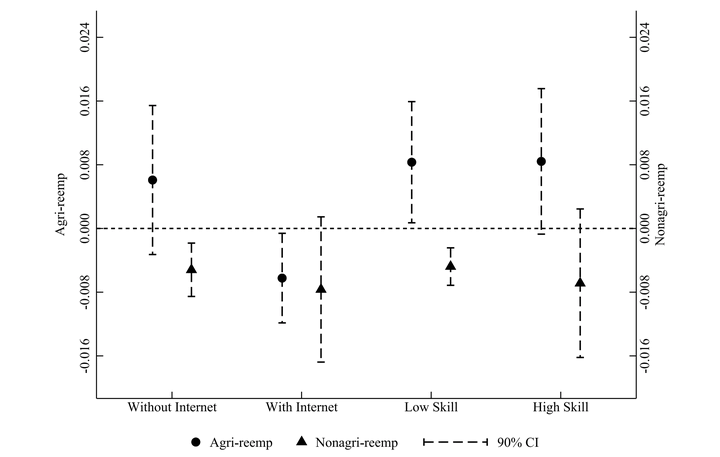
Abstract: Population aging and rapid automation are jointly reshaping labor markets in major economies, yet their interaction at older ages remains poorly understood. This paper examines how robot adoption shapes post-retirement reemployment among older individuals in China. Leveraging data from the China Health and Retirement Longitudinal Study (CHARLS) matched with industrial robot adoption from the International Federation of Robotics (IFR), we find that automation has no significant effect on aggregate post-retirement reemployment but substantially reshapes its sectoral composition. The share of retirees engaged in agricultural work rises while the share in non-agricultural work declines, with an expansion of agricultural self-employment alongside contractions in both self-employed and wage-based non-agricultural employment. This pattern is not driven by a contraction in aggregate non-agricultural hiring. Instead, it reflects adjustment frictions facing older workers with limited digital access and lower skills, and it is amplified among retirees under greater economic pressure from intergenerational transfers and constrained household resources. Non-agricultural reemployment continues to command a wage premium while agricultural returns decline as automation intensifies, widening sectoral earnings gaps among working retirees.

Weiwei Zheng
Assistant Research Fellow
My research interests include urban economics, labor economics, and spatial econometrics theory & application.